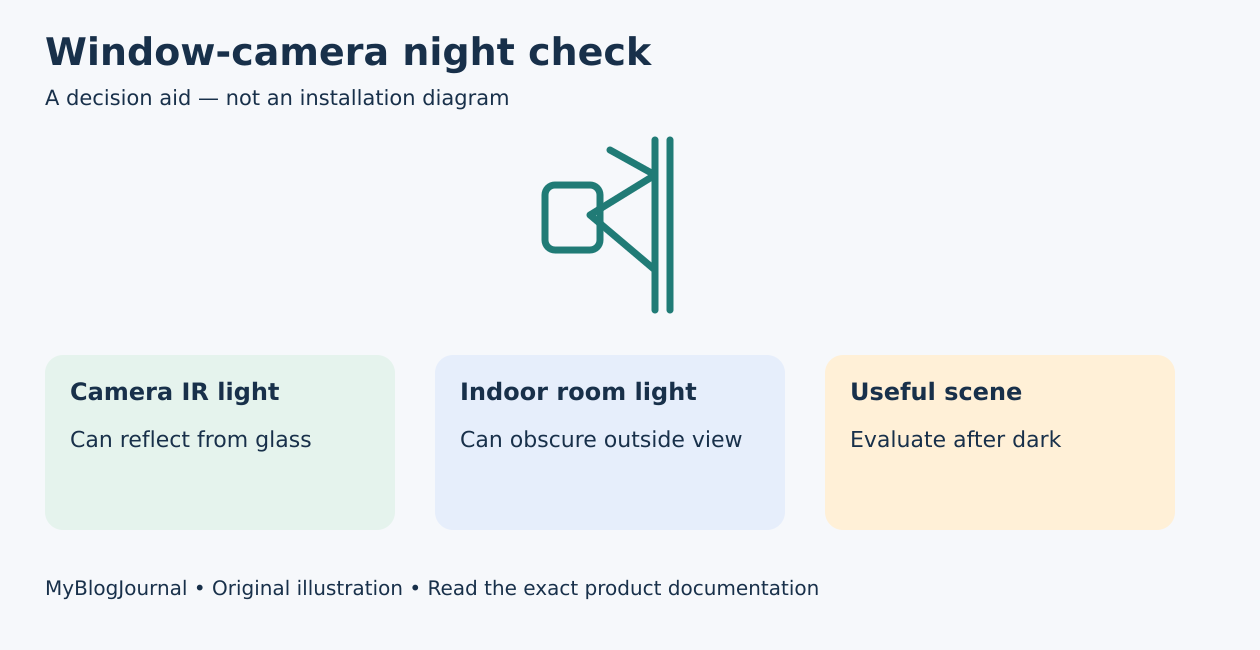
A clear daytime view through a window does not prove a camera will provide useful night footage. Infrared light and room lighting can reflect from the glass, obscuring what is outside. Check the actual evening scene before replacing the camera or paying for a plan.
Separate three causes of a poor view
TP-Link’s Kasa night-vision FAQ describes infrared glare from window glass. A camera’s own night illumination can return toward its lens instead of usefully illuminating the outside scene. Room lights and reflections introduce another variable; dirty glass or a nearby reflective surface can add to the problem.
| Observation | Question | Next evidence |
|---|---|---|
| White haze after dark | Is internal IR reflecting? | Exact camera night-mode guide |
| Room visible over the yard | Are indoor lights reflected? | Compare normal lighting conditions |
| Dark outside with IR off | Is outside illumination sufficient? | View actual intended scene |
| Useful live view, no useful clip | Is recording/detection configured? | Saved playback, not live view alone |
Define what useful means
Write a practical requirement before adjusting settings: see whether a parcel arrived, recognize a household vehicle, or inspect a general doorway. Avoid promising identification at a distance from a small preview. Include the intended time of day and lighting. Privacy boundaries and local rules still apply; do not aim into another person’s private space.
An observation sequence that changes one variable
Keep the camera secure and within its approved indoor environment. Check the manufacturer’s supported night-mode options, then compare the same scene with ordinary room lighting and with that lighting reduced if safe. Where the manual allows IR to be disabled, record the trade-off rather than assuming the remaining image is adequate. Do not cover ventilation or modify the camera to improvise a seal.
Review an actual saved clip after each observation, including playback on the device you will normally use. Keep settings, timestamp, room lights, outside lights, and outcome together. If an observation was not made, leave the box blank rather than recording a predicted pass.
Example: no subscription can remove the reflection
Hypothetical: a camera records a bright indoor lamp reflected in the window every night. A longer cloud-history plan preserves more of the same unusable view. The first buying decision is whether a manufacturer-supported location and lighting arrangement can meet the goal; storage is a separate decision.
If that cannot be established, consider a properly rated outdoor camera and supported installation, with permission where needed. Do not place an indoor-only camera outside. No setting guarantees useful footage under every weather or lighting condition.
Then choose storage
Once the view is useful, compare local versus cloud camera storage. Official guidance reviewed November 5, 2026; no footage, detection accuracy, or camera performance was tested by MyBlogJournal.
Featured diagram: original MyBlogJournal decision aid, created for this article. It is not an installation drawing or a product photograph. Links are informational; no affiliate relationship or paid placement is claimed.