
A short practice session is easier to start when its purpose is narrower than “get better.” Choose one skill, one exercise, and a way to inspect the result. This planning method can suit low-risk activities such as sketching, typing a passage, or practicing a presentation opening.
Define the part you want to practice
Replace “practice drawing” with “draw three simple objects while checking their relative proportions.” Replace “work on my talk” with “deliver the opening without reading every sentence.” The task should fit the time and tools available. Use appropriate instruction when the skill requires specialist guidance.
Prepare the example and materials
Have the reference, instructions, or sample ready before the session begins. If setup consumes most of the available time, reduce the exercise or prepare earlier. Do not use a time limit as a reason to skip necessary safety or preparation requirements.
Choose one feedback question
Ask something you can answer from the result. For a presentation opening: did you state the purpose clearly, and where did you lose your place? For a drawing: which proportions differ most from the reference? Avoid judging every aspect of performance at once.
If another person provides feedback, explain the focus. Checking pacing is different from redesigning the content. Record the observation in concrete terms rather than reducing the session to “good” or “bad.”
Try, inspect, and adjust
Make an initial attempt, inspect it, then repeat with one adjustment. Leave time to capture the result. A suggested ten-minute writing session might include setup, one attempt, a review, and one revision. Adapt the timing instead of treating it as a universal prescription.
If recording yourself, consider who can access the recording and whether other people are included. Store or remove the material appropriately when its practice purpose is finished.
End with the next useful exercise
Write what improved, what remains unclear, and the next thing to try. Limit the observation to what this session shows. One successful attempt does not establish permanent mastery; one difficult attempt does not settle your ability.
If the exercise was too difficult to produce useful feedback, simplify it. If it was easy but uninformative, choose a more specific challenge.
Use a personal experiment log to test whether the routine fits your schedule.
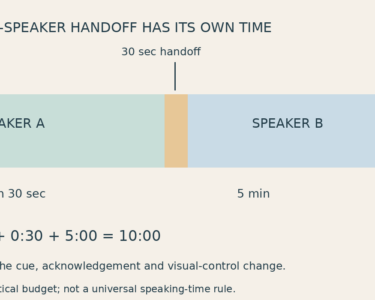
When the practice task involves two presenters, use the speaker-handoff cue sheet to assign the bridge, visual cue and shared timing before a joint rehearsal.