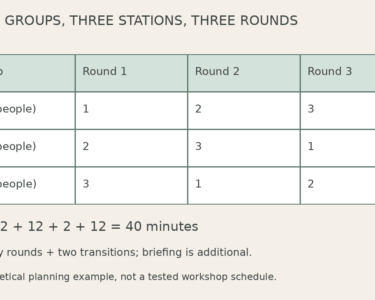
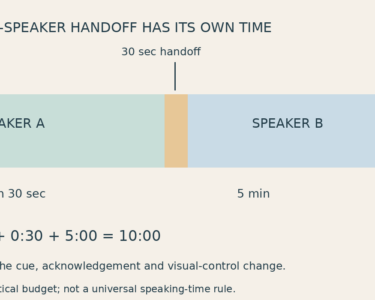
When two requests cannot both fit before their deadlines, ask for an explicit trade-off using the same short sheet for both. Show the outcomes, time available, estimates and consequence of each choice. Ask the person who can change the priorities to select an option rather than leaving you with two unchanged promises.
This is an original planning worksheet and fictional worked example. It is not a tested productivity intervention or a guarantee of how a manager, customer or collaborator will respond. Use it for ordinary planning decisions within your role; a proposed scope or deadline change still needs agreement from whoever owns it.
Copy the two-request sheet
Request A: deliverable; requester; confirmed due time; minimum acceptable scope; estimated work still required; what depends on it.
Request B: the same six fields.
Shared constraint: usable time before the deadlines, after existing commitments.
Decision needed: what must change, who can approve it, and when their answer is needed.
Write “unconfirmed” beside a date or requirement you have not checked. Separate “I need a draft to review” from “the finished version must be submitted.” If the two people use the word “done” differently, resolving that ambiguity may change the planning question. Do not quietly replace a final deliverable with a draft and call the conflict solved.
Worked example: four hours requested, three available
In this fictional case, a volunteer has three hours available before noon. A room-layout plan needs an estimated two hours, and an attendee information sheet needs another estimated two. The estimated demand is four hours, leaving a one-hour gap. These are planning assumptions, not observed completion times; uncertainty should stay visible.
Option A: finish the room plan and ask to move the full information sheet to an agreed later time. Option B: finish the information sheet and ask to move the room plan. Option C: ask whether one owner will accept a smaller, specifically described deliverable that fits the remaining hour. Another person’s help is an option only if they are available, have the necessary access and agree to the work.
Send a question someone can answer
Use your own details in this original message: “I have [usable time] before [deadline]. [A] needs about [estimate] and [B] about [estimate], so I cannot currently commit to both as defined. My recommendation is [option] because [confirmed consequence]. May I [specific change], or should I protect [alternative] instead? I need the decision by [time] to make the selected plan feasible.”
Avoid inventing a consequence to make your preferred option sound urgent. “The booking closes at noon” should come from the actual booking information; “this would be easier for me” is a preference and can be described honestly as one.
If the answer is “do both”
Ask which assumption changed: is there less scope, more time, a different dependency or additional agreed help? If none changed, repeat the constraint plainly and request a feasible choice. You can record a provisional sequence while awaiting a reply, but label it provisional. Silence does not establish that another person accepted a deadline change.
Close the loop after a decision
Record the selected option, approver, changed deliverable or due time, and who needs the update. Keep the original request linked so a later reader can see what changed. If your remaining estimate changes, reopen the question early with the new information rather than silently spending the time reserved for the second task.
Use our daily priority guide to establish available capacity, then record an approved change in a simple project change log.
Illustration: original MyBlogJournal hypothetical time-budget diagram.