A daily priority list is a decision about limited capacity, not a smaller copy of your entire backlog. First protect real commitments, then select a few concrete outcomes that fit the time and attention left. Anything else remains visible as unscheduled work rather than a promise to do it today.
Count available time honestly
Start with fixed appointments, necessary travel, caregiving, meals, and other commitments that already occupy the day. Include preparation and transitions. What remains is the starting capacity for flexible tasks. Do not treat a calendar with blank spaces as a day with no constraints, and do not plan as though every interval will be equally suitable for concentrated work.
Separate deadlines from pressure
For each apparently urgent item, ask what happens if it waits. A submission cutoff, a person blocked on your answer, and a self-imposed preference are different constraints. Check the original message or record when the date matters. If everything has been labeled urgent, bring the conflict to the person who can set priorities rather than pretending the calendar can hold it all.
Turn a project into a visible outcome
Replace sort the house with clear the kitchen table and return paperwork to its inbox. Replace work on application with gather the three required documents. A meaningful partial outcome is better than a vague plan to finish an oversized project. Choose something you can recognize as complete, and make dependencies explicit before reserving time.
Match the task to the available interval
Use a familiar estimate or a range for uncertain work. Reserve a suitable block for the most important outcome and identify a small fallback action for fragmented time. Avoid filling every remaining minute with tiny tasks simply because they are easy to check off. The right number of priorities depends on the size of the outcomes and the actual day, not a universal three-task rule.
Write down what will not happen today
Move the rest to a later review or leave it in the backlog. If postponing affects another person, communicate the revised expectation early. Do not silently roll every unfinished task into tomorrow’s must-do list. Cancellation, reduced scope, or a request for help may be a better decision than another date change.
Replan when the day changes
If an unexpected commitment consumes the planned work block, reconsider the remaining capacity. Choose a smaller useful outcome or defer the task deliberately. At the end of the day, note what was completed and the next step for anything important that remains. A priority system cannot eliminate excessive workload, but it can make the trade-offs visible enough to discuss and act on.
Related guide
Continue with connecting daily choices to a weekly plan. Reduce avoidable digital friction by stopping unwanted Chrome notifications and using a consistent file-naming system for household documents.
Featured photo: Dose Media on Unsplash, used under the Unsplash License. Illustrative stock photograph, not a product test or a screenshot of the steps.
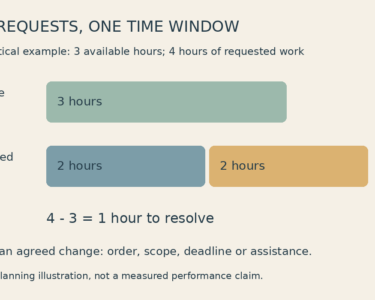
If two requesters need more work than the available time permits, use the two-request trade-off sheet to ask for a specific agreed change in scope, timing or help.