Before buying a weight bench, find out what the advertised capacity includes. A headline number may describe a combined load, a user limit, or a manufacturer-specific test condition. Do not subtract your body weight from it until the manual defines the rating.
Collect the rating, not just the largest number
REP’s bench guide lists model dimensions and capacities; its AB-3100 page is an example with a stated 700 lb capacity and flat/incline configuration. Those specifications do not establish the meaning of every competing bench’s capacity or suitability for your activity.
| Field | What to copy from the exact manual |
|---|---|
| Model/revision | Product identity and manual date |
| User limit | Separate body-weight limit if stated |
| Load definition | Combined or separately defined rating |
| Positions | Flat, incline, decline, attachment restrictions |
| Assembly/use | Required floor, adjustments, maintenance |
| Unclear wording | Manufacturer answer needed before use |
Use arithmetic only after the definition
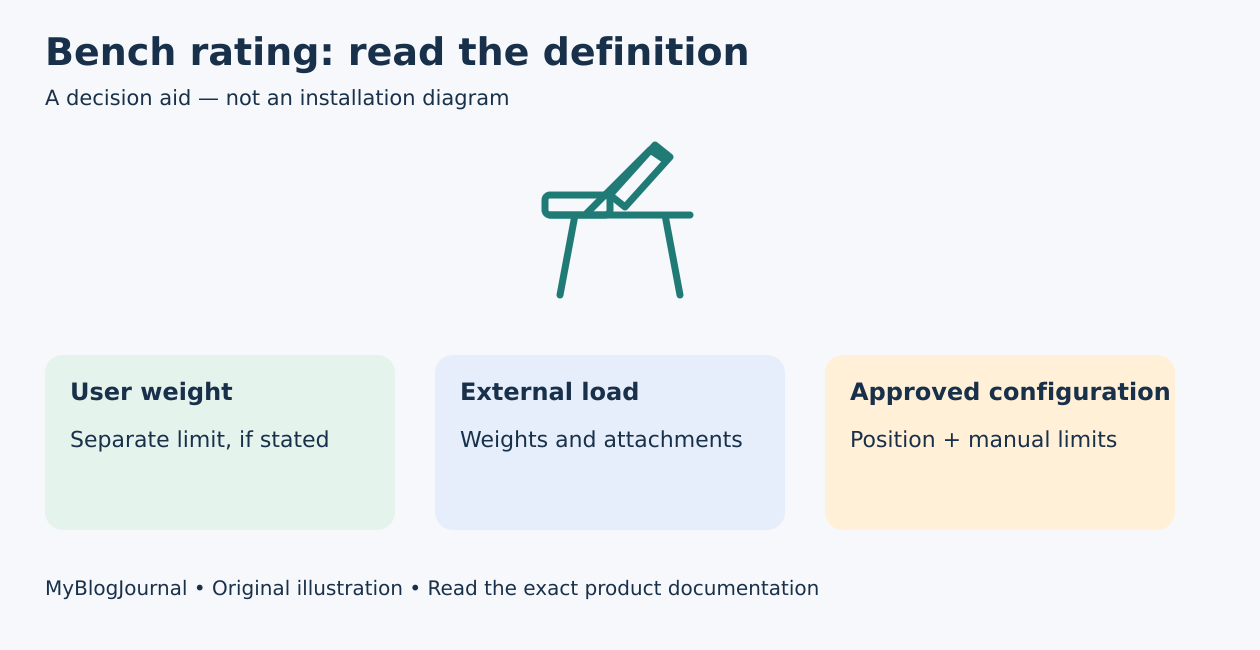
Hypothetical: a fictional manual explicitly defines a 400 lb limit as user plus external load. A 180 lb user with two 40 lb dumbbells creates a 260 lb total for that simple comparison. The calculation is 180 + 40 + 40, not 180 + 40. This is an arithmetic example, not an approved lifting setup, safety margin, or training prescription.
If the same fictional bench also has a 200 lb user limit, that separate limit still applies. A combined total below one rating does not cancel another restriction. If ratings vary by angle or attachment, use the applicable instructions rather than the most generous number on the sales page.
Capacity cannot answer every buying question
Check dimensions, pad arrangement, adjustment locking, assembled weight, storage instructions, and floor requirements. A high capacity does not prove the bench fits your room, supports a particular exercise, or is easy for you to move. Do not use unapproved vertical storage merely because another model can stand upright.
For used equipment, obtain the correct manual and check recalls and visible condition before purchasing. Missing hardware, damaged adjustments, or unknown modifications require an appropriate manufacturer or professional assessment. This article does not provide a structural inspection procedure or permission to repair a damaged bench.
A practical stop rule
Hold the purchase when the rating definition is unclear, the intended configuration is not covered, or the seller cannot identify the model. Ask for the exact manufacturer document rather than accepting an informal statement that the bench is “heavy duty.” Follow the instructions and obtain qualified exercise guidance if you are unsure about equipment use.
This is a small equipment-buying experiment supporting our beginner home-equipment guide, not a recommendation that every beginner needs a bench. Manufacturer information reviewed November 5, 2026; no load test, workout trial, or health outcome is claimed.
Featured diagram: original MyBlogJournal decision aid, created for this article. It is not an installation drawing or a product photograph. Links are informational; no affiliate relationship or paid placement is claimed.