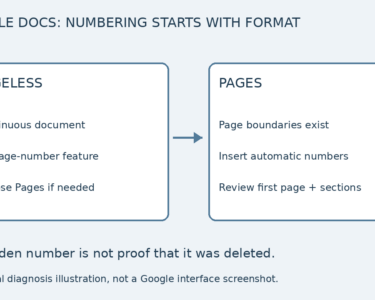
Pressing Enter repeatedly to push a heading onto another page makes the intended layout harder to understand. Google Docs has a page-break feature for a deliberate new page. First check that the document uses pages format, because the feature is not available in pageless format.
Insert the break
In a pages-format document, position your cursor where the new page should begin. Choose Insert, Break, then Page break. Inspect the text before and after the boundary to confirm it is where you intended.
Use paragraph-level page placement when appropriate
Google also provides Add page break before for a selected paragraph. Select the paragraph or place the cursor inside it, then use Format, Line & paragraph spacing, Add page break before. This can be useful when a heading should begin a new page.
Remove an unwanted page break carefully
Google’s removal instructions place the cursor below the page break and use Backspace or Delete until it is removed. Watch the content while doing this so you do not erase text unintentionally. Stop and inspect the boundary if the result is unclear.
A practical document example
Suppose a short report needs its appendix on a new page. Insert a deliberate break before the appendix instead of filling the preceding page with empty paragraphs. Revise the earlier text, then check whether the appendix still begins as intended.
Do not add a break simply to hide an unresolved layout problem. Check for unnecessary blank paragraphs or other formatting if an unexpected empty page remains.
Review the delivered format
If you will share a PDF or print the document, inspect that output separately. Confirm the heading, preceding paragraph, and following content are in the right places. A useful edit in the document should still be checked in the format the reader receives.
Keep structure and wording separate
A page break changes placement, not the meaning of a section. Keep headings descriptive and avoid using a new page as a substitute for explaining a transition. If a collaborator is reviewing only wording, tell them which layout choices are already intentional.
Use the feedback-request guide to specify whether a review should cover text, pagination, or both.
Source: Official Google instructions. Documentation checked October 19, 2026. Featured photo is illustrative, not an application screenshot.