
Three recipes can produce three separate shopping lists that all include the same ingredient. Combining them is straightforward until the units, ingredient forms, or package sizes differ. A consolidation sheet helps you total what is truly interchangeable before deciding what to buy.
Copy quantities with their units and forms
Write the ingredient exactly enough to identify it: fresh spinach, frozen chopped spinach, or cooked spinach may not be interchangeable in a recipe. Keep grams, cups, tablespoons, and counts visible. Do not add “one onion” to “one cup chopped onion” as if they were already the same measurement.
Group matching ingredients before doing the arithmetic
Place identical ingredients together, then add quantities expressed in the same unit. For example, 200 grams of dry rice for one recipe plus 150 grams for another requires 350 grams in total. If you have 100 usable grams at home, you need at least 250 more. The package you buy may contain more than that amount.
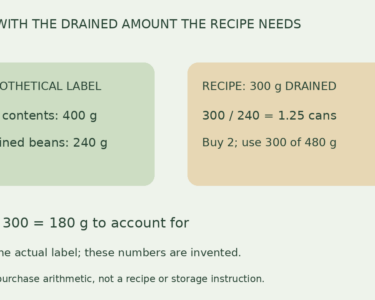
Keep incompatible or uncertain entries separate until you check the recipes. A tin’s total weight and its drained weight describe different quantities. Likewise, a recipe that calls for cooked beans needs a different interpretation from one starting with dry beans. Use the relevant label or recipe information instead of guessing a conversion.
Subtract only usable stock
Check the actual cupboard, fridge, or freezer. Count stock that is the correct ingredient, suitable for use, and available for these meals. If it is already reserved for another dish, note that reservation. Do not subtract an unopened package based on memory and discover later that someone used it.
Convert the requirement into a purchase
Keep two columns: amount needed and purchase decision. You might need 250 grams but buy one 500-gram bag. Write what will happen to the extra only if that helps your planning. Avoid increasing the number of recipes merely to justify a larger pack you do not otherwise need.
For loose produce sold by count, identify where an estimate is unavoidable. If the recipe’s precision matters, check its guidance instead of pretending a small and a large item are equivalent. Keep a note beside that ingredient so the uncertainty is visible in the shop.
Do one final duplicate check
Look for alternate names, repeated pantry staples, and ingredients hidden in sub-recipes such as a dressing. Keep the final list organized for the shop, but retain the recipe totals until shopping is complete. That makes it easier to resolve a substitution or package-size question.
For the stock check, start with a simple pantry inventory.
For canned beans, work out the drained quantity and whole-can purchase first; the focused example keeps package weight, recipe need and extra quantity separate.