Start with the moment you need light
A porch-light routine can run 20 minutes after sunset and still feel early in one season and late in another. Home Assistant’s documentation notes that twilight duration changes during the year. A sunset offset measures clock time relative to sunset; a dusk or descending sun-elevation trigger follows the sun’s position. Neither measures the brightness under your awning. Pick a real criterion, such as when you can no longer read a package label comfortably from the usual standing spot.
Compare without changing a working light
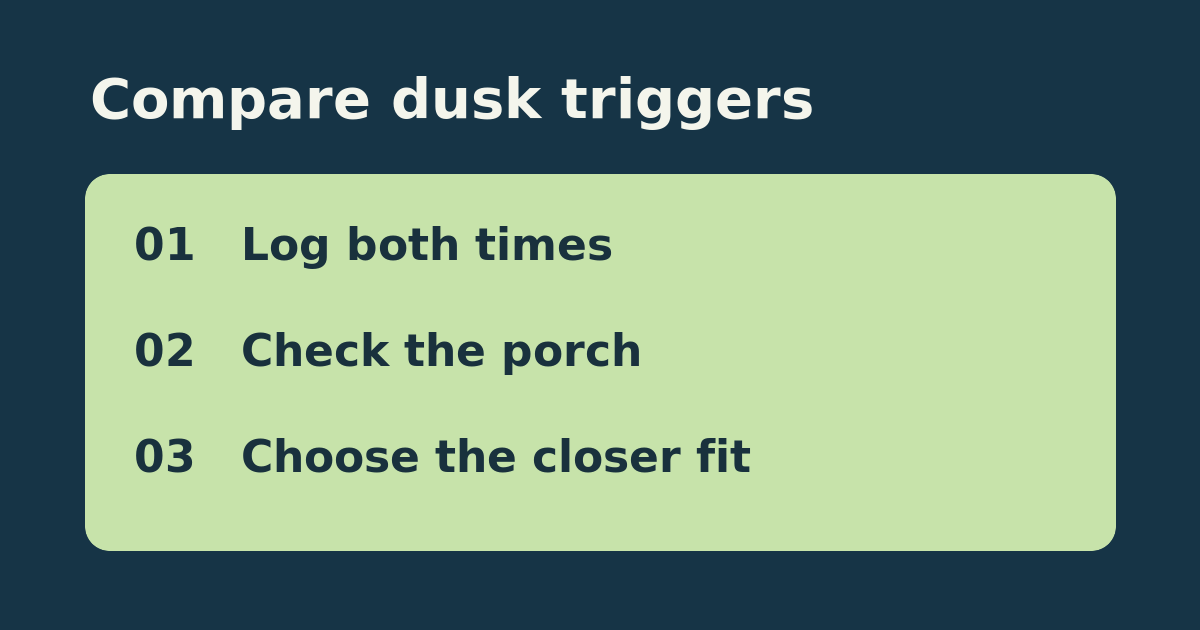
Leave the current routine in place. Set up two test automations that log their times without controlling anything: one at your existing sunset offset and one at dusk, or at a chosen descending elevation. Check the location and time zone first. At each logged time, jot down whether the porch is still bright enough for your chosen task. Include a clear evening and an overcast one if possible. Record the observation as well as the time; a timestamp alone cannot tell you whether a setting suits the porch.
Choose the simplest trigger that holds up
If dusk consistently matches the job more closely, change only the starter and keep the existing action and shutoff rule. If the offset already works, there is nothing to buy. If both differ mainly because of clouds, nearby buildings or shade, a local brightness sensor may be more useful; try an existing sensor at the actual decision point first. Revisit the choice in another season. Do not turn off any lighting you rely on for safe access just to run the comparison.
See the official setup instructions. Related guide: test recovery when a threshold is already crossed.