
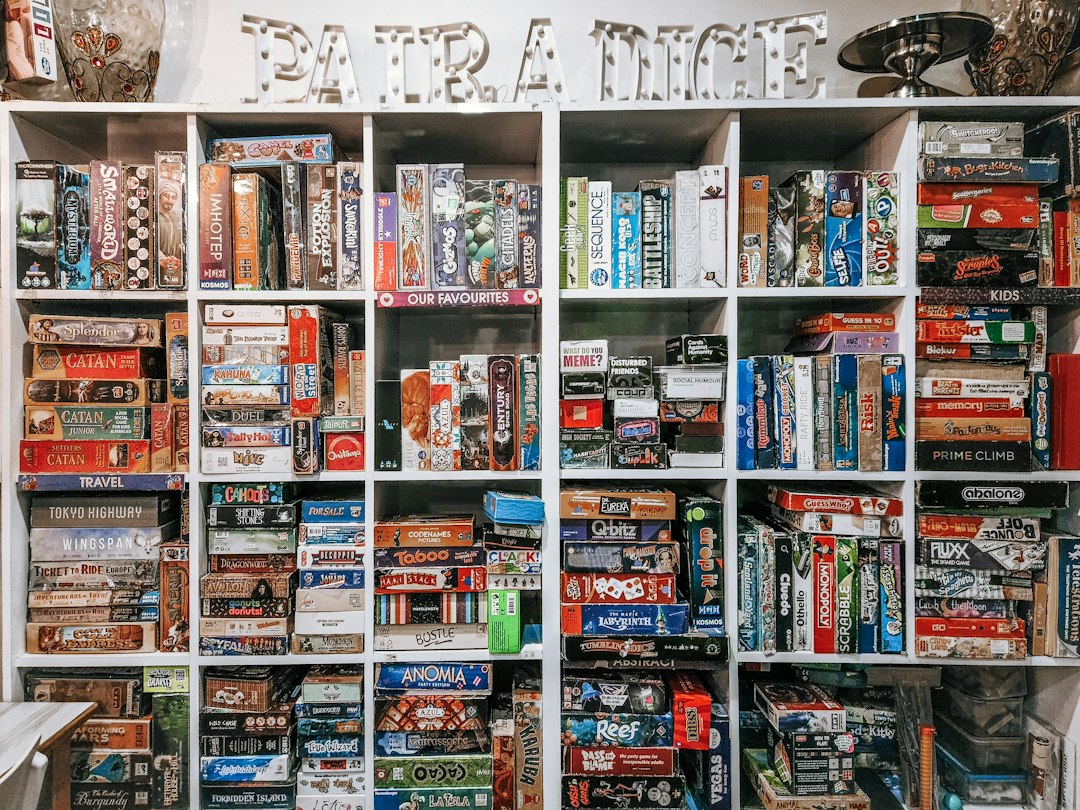
Store a board game so you can remove one box, find its pieces, and put everything back without dismantling the shelf. Before buying containers or discarding boxes, test the games you already own in the actual space. Some inserts hold pieces securely only when the box stays flat.
The method below is a proposed household organizing system, with a hypothetical measurement example. It does not assume every game can be stored upright or promise a fixed percentage of space savings.
Start with a complete-game check
Choose one shelf and lay out its games on a clear table. For each game, check the components against its own rules or component list. Keep an uncertain game together with a note describing the missing piece. A loose token should not be assigned to a different game just because its color looks right.
Sort into three decisions: ready to play, needs a component check, and needs a household decision about keeping it. A game that is awaiting a replacement part should not quietly return to the ready-to-play section.
Measure the box in its intended position
Record the shelf’s usable width, depth and height. Measure the box with its lid fully seated, including any bulge from bags or accessories. Check whether the shelf door, hinge or neighboring furniture reduces the opening. You need room for your hand as well as the box.
Hypothetical example: A shelf is 72 cm wide and 32 cm deep. Three flat boxes each occupy 24 cm across the shelf. The arithmetic says 24 + 24 + 24 = 72, but that leaves no side clearance. Test removal before calling this a workable arrangement. Place two boxes there and use the remaining space for a smaller game if that is easier to handle.
If the shelf itself is awkward, use the measurement approach in our shelf and storage-bin fit guide before shopping. A container cannot solve an opening that is too small.
Choose flat or upright for each game
Open a box and look at what holds its contents in place. An insert with open compartments may spill when turned on its edge. A board can also shift against cards or other components. Try a gentle orientation test over a clear table, then reopen the box to see what moved.
Keep a box flat if its insert needs that position or its condition makes upright storage unstable. If upright storage works, keep the title visible and check that the lid stays closed. Do not force an overfilled box between neighboring games.
Avoid a tall stack that requires moving several heavy boxes to reach the one you use most. Put frequently played games in the easiest usable positions. Follow the furniture maker’s load and installation instructions; this guide does not establish a shelf’s weight rating.
Give loose pieces a named home
Use existing suitable component containers before purchasing a matching set. Label the container with the full game name and expansion, if relevant. If several sets of pieces are used at different stages of play, preserve those distinctions so setup does not become a sorting task.
Keep rules and reference cards with the game. Before removing packaging, consider whether it contains setup information or keeps fragile pieces separated. Rehousing everything into identical boxes may make titles harder to distinguish or separate components from their instructions.
Small playing pieces and plastic bags require age-appropriate storage. Follow the game’s age guidance and keep unsuitable components away from young children.
Make a return routine that fits one game
After playing, separate components by the game’s existing categories, check around and under the table, return the rules, and seat the lid without pressure. Put the box back in its assigned position. If something is missing, attach a visible note instead of hiding the problem until the next game night.
A useful shelf label names the games that belong there rather than saying only “games.” For example: “Two-player games: blue card box, travel chess, tile game.” Adapt the names to what your household actually recognizes.
Review after the next two game nights
Observe what goes wrong: a lid that slides off, a box that needs two hands while another falls over, or a component container that never returns. Change that specific arrangement. Do not reorganize the entire collection because one box needs a better spot.
Your success check is practical: can a household member identify the game, remove it, find the rules and components, and return it to the same location? If so, the storage is doing its job even when the shelf does not look perfectly uniform.
Photo: Zoshua Colah on Unsplash, used under the Unsplash License.


