To make fewer servings, scale ingredient quantities first, then reconsider the cookware and cooking method. Half the ingredients does not automatically mean half the cooking time. This beginner worksheet is for ordinary dinner recipes—not canning, curing, or another preservation process that requires a tested formula.
Calculate one scale factor
Divide desired servings by original servings. To turn a four-serving dinner into two servings, the factor is 2 ÷ 4 = 0.5. Multiply each ingredient quantity by that factor. Write a new ingredient list before starting so you do not halve the first ingredients and accidentally use full quantities for the rest.
Use a few clear conversion examples
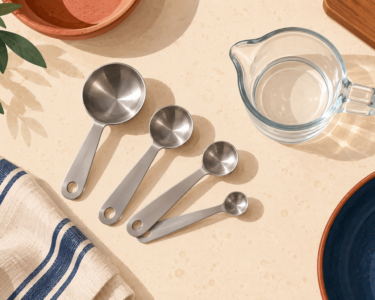
For a half batch, 2 cups becomes 1 cup, 1 tablespoon becomes 1½ teaspoons, and ¾ cup becomes ⅜ cup, which is 6 tablespoons using US customary measures. A kitchen scale can simplify quantities when the original recipe provides weights. Keep units consistent; do not multiply a number in grams and then label the result ounces.
Think before splitting awkward ingredients
Half an onion can be reserved appropriately for another meal. Half an egg is less convenient; for a recipe that can tolerate this adjustment, you can beat the egg and measure half, handling and cooking it safely. If the dish depends on exact proportions, choose a recipe already written for your desired yield rather than improvising around several awkward fractions.
Choose cookware that fits the new quantity
A much smaller quantity spread in a large pan can behave differently from the original batch. Consider depth, surface area, and crowding. Start with the recipe’s intended method and watch the food, not a simple percentage of the original time. Baking, rice absorption, and thick sauces may require more recipe-specific adjustments than a straightforward vegetable side.
Keep seasoning adjustable where practical
Measure rather than assuming a large shake equals a fraction of a teaspoon. For a flexible savory dish, you can reserve some finishing seasoning and adjust after safe cooking. This does not apply to the safety-critical proportions in preservation recipes. Do not alter canning formulas using this household scaling worksheet.
Record the result for next time
Write the new ingredient amounts, pan used, approximate timing observations, and whether the yield matched your needs. Label the note as your adaptation, not as a tested universal conversion. If the first smaller batch is disappointing, change one variable next time rather than increasing heat, liquid, and seasoning simultaneously. The arithmetic gives a starting point; the actual cooking method still needs judgment.
Related guide
Continue with shopping for one person with less unused food.
Source and further reading
University of Maryland Extension: scaling and ingredient measurement. Guidance checked October 16, 2026; interfaces and product instructions may change.
Featured photograph: Douglas Fehr on Unsplash, used under the Unsplash License. Illustrative stock photo, not a screenshot, product test, or demonstration of every instruction.
Before converting an awkward ingredient amount, distinguish grams from milliliters; halving a quantity does not turn a volume measure into a mass measure.