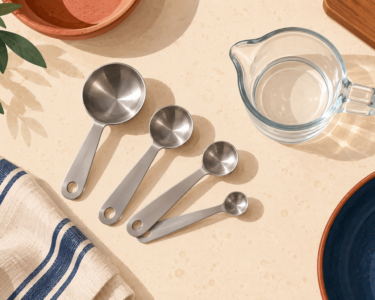
Grams measure mass; milliliters measure volume. They are not interchangeable units for every ingredient. Use a suitable scale for a gram quantity and an appropriate volume measure for a milliliter quantity unless the recipe or a reliable ingredient-specific source supplies the conversion.
This matters when cooking for one or two because a small unit mistake is still a unit mistake. Dividing a recipe correctly will not fix measuring a different kind of quantity.
Read the unit before choosing the tool
NIST’s cooking measurement reference distinguishes capacity units from mass units. In a recipe, g means grams, kg means kilograms, mL means milliliters and L means liters. Volume can describe dry ingredients as well as liquids; the ingredient being dry does not turn a cup into a mass unit.
Keep conversions within the same kind of quantity when possible: 1 kg is 1,000 g and 1 L is 1,000 mL. Changing grams to milliliters needs information about the material’s density, not merely a different setting on the display.
Why the water shortcut is not universal
NIST uses an approximate water-mass relationship when estimating bakeware volume. That does not establish a universal gram-to-milliliter rule for flour, oil or other ingredients. Their physical properties and, for loose dry ingredients, the way a volume is filled can affect the relationship. Do not use an unsourced conversion chart as though every ingredient has the same value.
If the recipe gives grams, weigh that ingredient in grams. If it gives a volume and no reliable mass equivalent, measure the stated volume. If it gives both and they appear inconsistent, seek clarification from the recipe publisher rather than averaging unlike units.
Tare separates the bowl from the ingredient
NIST recommends zeroing, or taring, the scale with the vessel and previously added ingredients in place before the next measurement. See its kitchen-tool guidance. Follow the actual scale manual for units, capacity and operation. Taring the display does not make the physical bowl weight disappear from the scale’s load.
Illustrative arithmetic: a bowl has a mass of 280 g. With 120 g of an ingredient, the combined mass is 400 g. Taring the empty bowl first lets the display show the added 120 g. These are invented teaching quantities, not ingredient recommendations or a calibration test.
| Situation | What to record or do |
|---|---|
| Recipe says 120 g | Use gram mode and a suitable scale |
| Recipe says 120 mL | Use an appropriate volume measure, or a verified conversion for that ingredient |
| Display shows bowl plus contents | Tare correctly before adding, or account for the vessel’s mass |
| Amount is below the scale’s useful range | Consult its manual and the recipe’s intended measuring method |
| Scale offers a volume mode | Check which liquid and assumptions its manufacturer specifies |
Keep a short measurement note
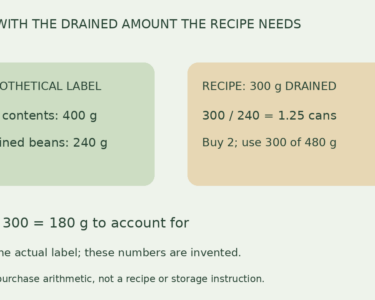
For a recipe you plan to repeat, note the ingredient, the original unit, the tool and any verified conversion source. Record the recipe’s preparation instruction too: a chopped or drained ingredient is not necessarily measured at the same stage as an unprepared one. Do not invent a substitute instruction when the recipe is unclear.
An example note could read: ingredient A, 120 g, weighed after taring; ingredient B, 80 mL, measured as volume; no gram conversion assumed. The labels are deliberate placeholders. This is a measurement record, not a tested recipe.
Scale the quantity only after resolving the unit
Once the unit is clear, use the recipe-halving guide for arithmetic. Temperature safety is a separate question; consult the food-thermometer guide when checking a cooked food.
NIST sources checked October 16, 2026. Examples and the featured measurement schematic are original MyBlogJournal illustrations; no recipe testing, cooking-time validation or scale-accuracy test is claimed.