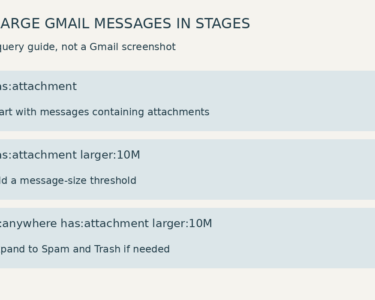
For personal Gmail, attachments are limited to a combined 25 MB; larger files are generally sent through a Google Drive link instead. Before trying again, check whether the recipient needs the original file, a smaller copy, or access to a shared document. Managed-account rules can differ.
Identify the actual transfer problem
Check the attachment size and the error message. A missing file, blocked format, slow connection, and a recipient permission problem need different fixes. Do not keep resending an identical large message without knowing which step failed. If the attachment contains sensitive information, stop before uploading it to an unfamiliar compression or transfer service.
Send a smaller copy when quality allows
For ordinary photographs or a presentation preview, a reduced-size export may meet the reader’s need. Use a trusted application and preserve the original. Open the exported copy and confirm that text, photos, and page order are still usable. Renaming a file or changing its extension will not reduce its size or convert the format.
Use a Drive link when the original matters
If the recipient needs the full-resolution file or an ongoing shared document, a Drive link can be more appropriate. Upload to the correct account and share with the intended person using the required role. Check that the shared object is the file you meant to send, not a folder containing unrelated documents.
Verify access separately from delivery
A delivered email does not establish that its link is usable by the recipient. Check the email address invited and whether the person is opening the link under that account. Keep sensitive material restricted; do not make it public simply to eliminate an access request. Work or school sharing policies may limit external access and should not be bypassed.
Use ZIP files only for the right reason
An archive can keep several related files together, but it may not substantially shrink already-compressed photos or video. The recipient also needs an approved way to open it. Avoid password-protected archives as a workaround for an organization’s attachment rules. Confirm the accepted transfer method with the recipient instead.
Finish with a useful message
Tell the recipient what the file is, whether it is a preview or the original, and what action you need. Confirm successful access when timing matters, then review whether ongoing sharing is necessary. A smaller attachment solves a size problem; a controlled link solves a transfer-and-access problem. Neither replaces a backup of your important original.
Related guide
Continue with sharing a Drive file without making it public.
Source and further reading
Gmail Help: attachment limits and Drive links. Guidance checked October 16, 2026; interfaces and product instructions may change.
Featured photograph: Anete Lūsiņa on Unsplash, used under the Unsplash License. Illustrative stock photo, not a screenshot, product test, or demonstration of every instruction.