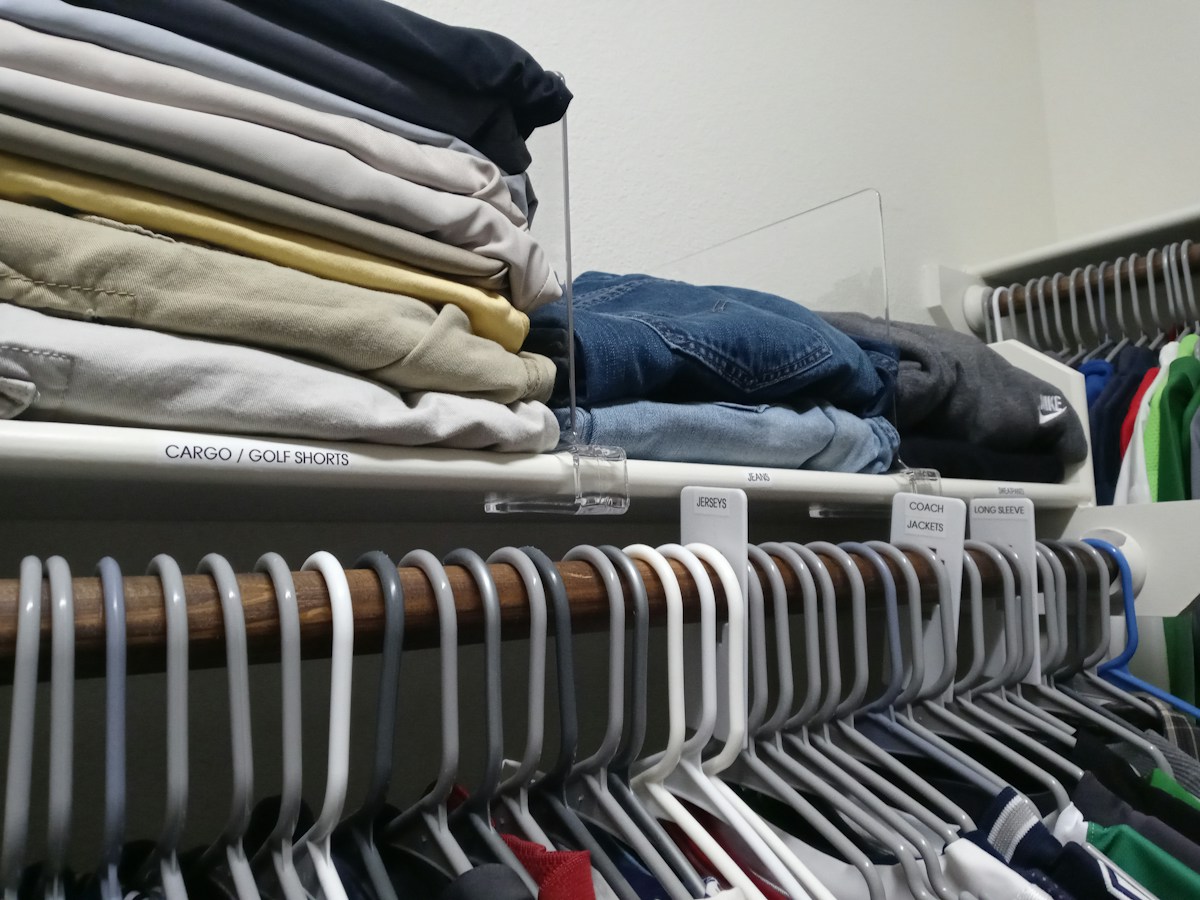
If folded clothes repeatedly fall across a closet shelf, start by reducing the stack and testing how you remove one item. Shelf dividers can separate groups, but they cannot make a stack easy to use if it is too tall, too tightly packed, or beyond your comfortable reach.
Find the point where the stack fails
Choose one shelf and remove only its contents. Sort by items that stack similarly, such as the same kind of T-shirt or towel. Mixing slippery, bulky, and small items can create an uneven pile. Return a short stack and remove an item as you normally would. Watch whether the pile leans before you touch it or collapses when you pull something from the middle.
If it leans immediately, try a more consistent fold and a smaller group. If removal causes the problem, use fewer layers or a different storage method for frequently used pieces. Avoid solving a retrieval problem by pushing the clothes farther back where you cannot see them.
Test reach and visibility
Keep everyday groups where you can reach them without pulling the entire pile toward the shelf edge. If the shelf is deep, do not assume two rows will work: you need to identify the back row and reach it without dismantling the front one. A labeled container may work better for occasional items, provided you can remove it safely.
Treat the remaining space as access space, not automatically wasted capacity. A shelf filled to its upper edge may hold more clothes while making every retrieval awkward. Try the layout for several normal uses before adding more items.
Choose a divider only after a fit check
Measure the shelf’s thickness, usable depth, and vertical clearance. Check the divider’s attachment method and compatible shelf range against its product instructions. Make sure a clip or base will not interfere with clothing or an adjacent door. For rentals, consider whether the fitting can mark the shelf; do not assume every removable accessory is damage-free.
A divider should help keep neighboring groups separate. It is not a load-bearing shelf support unless the manufacturer explicitly designed it as one. Do not force a clip onto an incompatible shelf or use it to support heavy stored objects.
Use a small maintenance rule
Give each group a boundary you can recognize. When it repeatedly exceeds that space, review the items or change the layout instead of making the stack taller. For the earlier decision about what belongs in the closet, see our closet decluttering guide. This original layout method addresses keeping folded groups accessible after that decision.
Photo: Cabri Caldwell / Unsplash. Illustrative stock photograph.